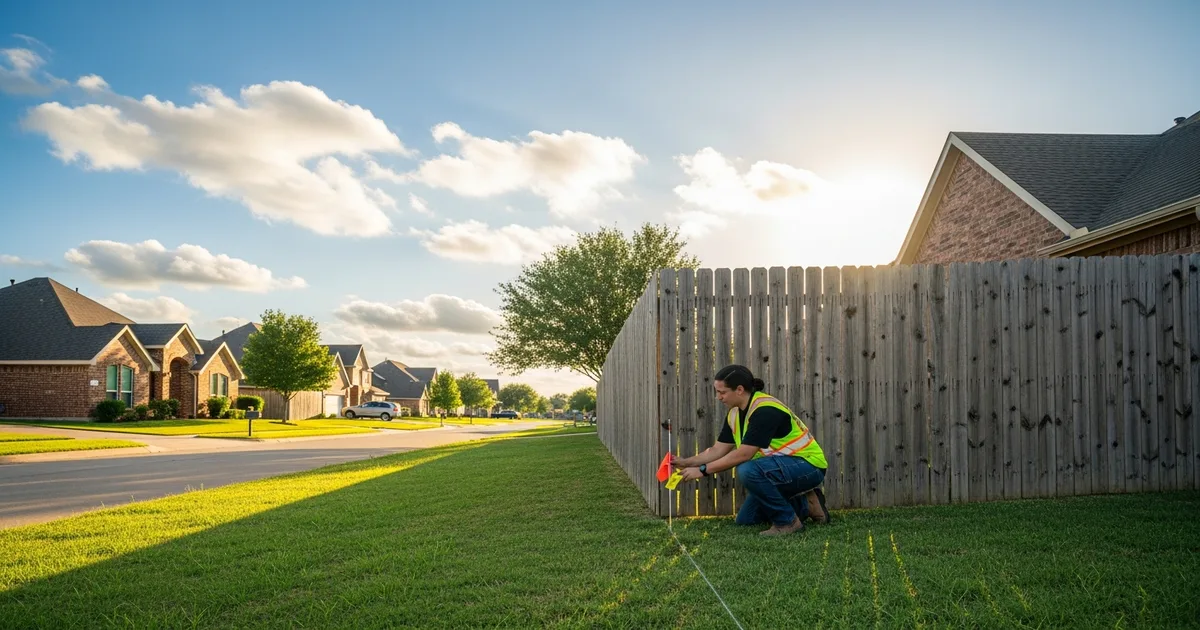
Building a fence in Denton sounds straightforward until you hit the permit requirements, HOA restrictions, and setback rules that trip up homeowners every week. Here’s what you actually need to know before you start digging post holes.
City of Denton Fence Permit Basics
The City of Denton requires a permit for all new fences and full replacements. Repairs that replace less than 50% of an existing fence generally don’t require a new permit.
What you need to apply:
- A completed fence permit application (available at Denton Development Services or online)
- A site plan showing your property lines, the proposed fence location, and dimensions
- $50 permit fee for residential properties
- Proof of property survey if your fence sits within 6 inches of a property line
Processing typically takes 3–5 business days. Don’t start building before the permit is approved — the city can require you to tear down unpermitted fences.
Height and Setback Requirements
| Location | Maximum Height | Notes |
|---|---|---|
| Front yard | 4 feet | Must not obstruct visibility triangle at intersections |
| Side yard (interior lot) | 8 feet | Must stay behind the front building line |
| Rear yard | 8 feet | Standard for most residential lots |
| Corner lot (street-facing side) | 4 feet in visibility area | 25-foot triangle from intersection point |
| Alley-facing | 8 feet | Must not encroach on alley right-of-way |
Setbacks: Fences can be built up to the property line, but the finished side (the “good” side) must face outward toward neighbors. Denton code requires this — it’s not just etiquette.
HOA Rules That Catch Homeowners Off Guard
If you live in a Denton subdivision with an HOA — and most neighborhoods built after 2000 in areas like Robson Ranch, Rayzor Ranch, or the subdivisions off Teasley Lane have them — your HOA almost certainly has additional fence requirements.
Common HOA restrictions in Denton neighborhoods:
- Material requirements — Many HOAs mandate cedar or treated wood and prohibit chain-link in rear yards
- Color restrictions — Natural wood stain or specific paint colors only
- Pre-approval — Most HOAs require you to submit a fence plan and get written approval before you apply for the city permit
- Shared fence agreements — Some HOAs have specific rules about cost-sharing with adjacent homeowners
Always check your HOA covenants first. Getting a city permit doesn’t protect you from an HOA violation.
Denton Soil and Weather Considerations
Denton County’s expansive clay soil is the single biggest factor in fence longevity. Clay soil swells when wet and shrinks when dry, which causes fence posts to heave, lean, and eventually fail.
Best practices for Denton fence installations:
- Post depth — Dig post holes 36 inches deep minimum (many contractors go 42 inches in heavy clay areas)
- Concrete footings — Required for stability in clay soil. Quick-set concrete is common but poured concrete holds better long-term
- Post material — Pressure-treated 4x4 posts are minimum; steel posts in concrete last significantly longer in clay
- Drainage — Add 3–4 inches of gravel at the bottom of each post hole before pouring concrete
North Texas wind is the other factor. Denton averages sustained winds of 10–15 mph with spring gusts over 40 mph. Solid wood privacy fences catch wind like a sail — consider a fence style with small gaps or a shadowbox design if your yard faces the prevailing south wind.
Get a Fence Estimate from a Local Pro
Denton Home Services connects you with licensed, insured fence contractors who know local code and HOA requirements. Free estimates, no trip fees.
Get Matched with a Fence Contractor →Typical Fence Costs in Denton
| Fence Type | Cost per Linear Foot | 150 ft Yard Estimate |
|---|---|---|
| Cedar privacy (6 ft) | $25 – $40 | $3,750 – $6,000 |
| Treated pine privacy (6 ft) | $18 – $30 | $2,700 – $4,500 |
| Chain-link (4 ft) | $12 – $22 | $1,800 – $3,300 |
| Wrought iron / steel | $30 – $55 | $4,500 – $8,250 |
| Vinyl privacy (6 ft) | $28 – $45 | $4,200 – $6,750 |
Prices reflect Denton-area contractor rates as of early 2026. Gate installations, removal of old fencing, and grading add to total cost.
Bottom Line
Get your HOA approval first, then your city permit, then build. Skipping either step can cost you more in fines and forced removal than the fence itself. And in Denton’s clay soil, don’t cut corners on post depth and footings — a fence that leans after the first wet season is a fence you’re paying for twice.