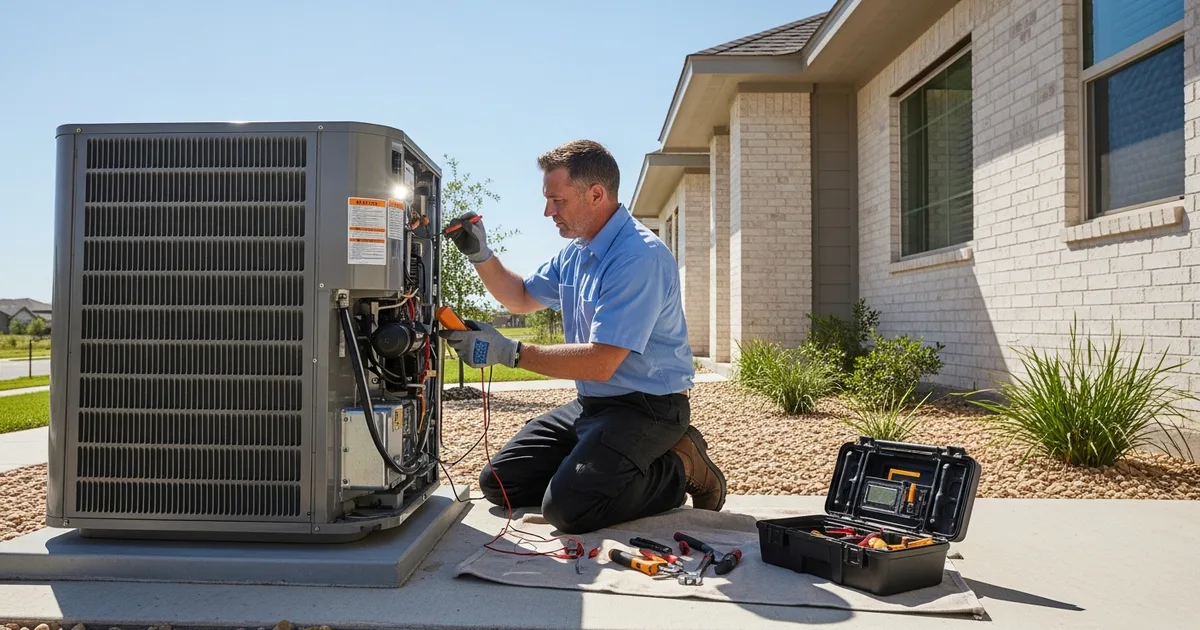
Denton summers are unforgiving. When it’s 105 degrees outside and your AC quits, you’re looking at a house that hits 90+ degrees within hours — and an emergency repair call that costs double the normal rate because every HVAC tech in town is booked solid.
The good news: AC systems rarely die without warning. They send signals for weeks or months before the final breakdown. Here are the seven signs Denton homeowners should watch for — and what each one means.
1. Weak or Reduced Airflow
Put your hand over a supply vent while the system is running. You should feel a strong, steady push of cold air. If the airflow feels weak or barely noticeable, something is restricting it.
Common causes in Denton homes:
- Clogged air filter — The number one cause. Denton’s pollen season (March–May) and general dust load mean filters clog faster here than in less arid climates. Check your filter monthly during summer
- Failing blower motor — The fan that pushes air through your ducts. When bearings wear out, it slows down before it stops completely
- Collapsed or disconnected ductwork — Especially common in Denton attics where temperatures hit 140+ degrees. The extreme heat degrades duct tape and mastic sealant over time, causing sections to separate or collapse
- Frozen evaporator coil — Low refrigerant causes the coil to freeze, blocking airflow. You might notice ice on the refrigerant lines going to your outdoor unit
What to do: Start with the filter. If that’s not the issue, call for a diagnostic before the blower motor burns out completely — a motor replacement ($300–$700) is much cheaper than an emergency replacement in July.
2. Warm Air Coming from Vents
Your AC is running, the thermostat says 72, but the air coming from the vents feels lukewarm or room temperature. This is the most obvious sign of a system in trouble.
Common causes:
- Low refrigerant — Your system doesn’t “use up” refrigerant. If it’s low, you have a leak. Refrigerant leaks get worse over time, not better
- Compressor failure — The compressor is the heart of your AC. When it starts failing, it can’t adequately compress refrigerant, and cooling capacity drops
- Thermostat malfunction — Sometimes it’s not the AC at all. A faulty thermostat may not be communicating the correct setpoint to the system
- Outdoor unit obstruction — The condenser unit outside needs clear airflow. Denton’s fast-growing vegetation can encroach — keep 2 feet of clearance on all sides
What to do: Check the outdoor unit for debris and make sure the thermostat is set correctly. If the air temperature at the supply vent is less than 15 degrees cooler than the return air, you need a professional. This isn’t a DIY fix.
3. Strange Noises
A healthy AC system makes a consistent low hum. New or unusual sounds mean mechanical problems are developing.
What each noise means:
| Noise | Likely Cause | Urgency |
|---|---|---|
| Grinding or metal-on-metal | Worn blower motor bearings | High — motor failure imminent |
| Squealing or screeching | Belt slipping or fan motor issue | Medium — will worsen quickly |
| Banging or clanking | Loose or broken component inside unit | High — can cause secondary damage |
| Clicking (rapid, repeated) | Electrical relay or control board issue | Medium — could indicate electrical problem |
| Hissing or bubbling | Refrigerant leak | High — losing cooling capacity |
| Rattling from outdoor unit | Loose screws, debris in unit, or failing compressor mounts | Low to medium — inspect soon |
What to do: Don’t ignore mechanical noises. A $200 bearing replacement today prevents a $700 blower motor replacement next month. And a refrigerant hiss means you’re losing cooling capacity every day you wait.
4. Frequent Cycling (Short Cycling)
Your AC should run in consistent cycles — on for 10–20 minutes, off for a similar period. If it’s turning on and off every few minutes, that’s short cycling, and it’s hard on the compressor.
Common causes in Denton:
- Oversized system — A unit that’s too big for your home cools the space too quickly, then shuts off before properly dehumidifying. This is surprisingly common in Denton — some contractors install oversized systems thinking “bigger is better” for Texas heat
- Failing compressor — A compressor on its way out may trip on thermal overload, shut down, cool off, restart, and repeat
- Dirty condenser coil — The outdoor coil gets caked with pollen, dust, cottonwood fuzz, and grass clippings. When it can’t release heat efficiently, the system overheats and cycles off
- Refrigerant issues — Both overcharged and undercharged systems can short-cycle
What to do: Clean the outdoor unit with a garden hose (gently — don’t bend the fins). If short cycling continues, call for a diagnostic. Every short cycle puts stress on the compressor, and compressor replacement is the most expensive repair in HVAC — $1,800–$3,500.
5. Unexplained Spike in Electric Bills
If your Oncor bill jumped $50–$100+ compared to the same month last year and your rates haven’t changed significantly, your AC is likely working harder than it should be.
Why this happens:
A system losing efficiency runs longer to maintain the same temperature. A 10-year-old system that once cooled your home in 15-minute cycles may now run for 30 minutes per cycle. That’s double the electricity for the same result.
Common efficiency killers in Denton:
- Low refrigerant (even slightly low reduces efficiency dramatically)
- Dirty coils (both indoor and outdoor)
- Aging compressor losing compression
- Leaky ductwork in a 140-degree attic
- Clogged filter restricting airflow
What to do: Compare your kWh usage year-over-year (Oncor’s SmartMeter portal makes this easy). If usage is up 20%+ with no lifestyle changes, your system is declining. A $100–$200 tune-up may restore some efficiency, but if the system is 12+ years old, start budgeting for replacement.
6. Excess Humidity Inside
Your AC doesn’t just cool air — it removes moisture. In Denton’s humid spring months (April–June), a properly functioning system keeps indoor humidity between 40–50%. If your home feels sticky or clammy even with the AC running, something is wrong.
Common causes:
- Oversized system — Cools too fast, shuts off before adequately dehumidifying. The air is cold but damp
- Aging system — Older systems lose dehumidification capacity as components wear
- Evaporator coil issues — A dirty or damaged coil can’t efficiently remove moisture from the air
- Thermostat fan setting — Make sure it’s set to “Auto” not “On.” The “On” setting runs the fan continuously, which re-evaporates moisture from the coil back into your air
What to do: Check the thermostat fan setting first. If it’s on Auto and you’re still humid, the system needs professional attention. Excess humidity also promotes mold growth — a serious issue in Denton homes, especially in bathrooms and closets against exterior walls.
7. Water Leaking Around the Indoor Unit
If you see water pooling around your indoor unit (usually in the attic or a utility closet), act immediately. This is both a sign of AC trouble and a potential property damage issue.
Common causes:
- Clogged condensate drain line — The most frequent cause. Denton’s hard water accelerates mineral buildup in the drain line. Algae and mold can also clog it, especially in humid spring months
- Cracked or overflowing drain pan — The pan under your evaporator coil catches condensation. Rust or cracks cause leaks
- Frozen evaporator coil thawing — When a frozen coil melts, it produces more water than the drain pan can handle
- Improper installation — If the unit isn’t level or the drain line has incorrect slope, water backs up
What to do: If water is actively dripping into your ceiling or walls, turn off the AC immediately to prevent further damage. A clogged drain line is a $100–$200 fix. Water damage to your ceiling is a $1,000+ repair. Don’t wait on this one.
The Denton Timeline: When These Signs Matter Most
In North Texas, timing matters:
- March–April: Schedule your annual tune-up NOW, before every HVAC company is booked. This catches most of the issues above
- May: If you’ve noticed any warning signs, get them addressed before temperatures hit 95+. Wait lists for repairs grow to 3–5 days by late May
- June–August: Emergency territory. If your AC fails in peak summer, you’ll pay premium rates and may wait 24–48 hours for service. Temperatures inside an un-cooled Denton home can reach 90+ degrees within 3–4 hours
- September–October: Great time for replacement if your system barely survived the summer. Contractors offer off-season pricing and availability is wide open
What a Tune-Up Catches
A professional pre-summer tune-up ($100–$200) checks every item on this list:
- Refrigerant level measurement
- Electrical connection inspection and tightening
- Capacitor testing (the #1 failure point on Denton AC systems)
- Condenser and evaporator coil cleaning
- Drain line flushing
- Blower motor amp draw testing
- Thermostat calibration
- Air filter replacement
Most Denton HVAC companies offer maintenance plans at $150–$300/year that include two tune-ups (spring and fall) plus a 10–15% discount on repairs.
Don't Wait for the Breakdown
If your AC is showing any of these warning signs, get ahead of it. Denton Home Services connects you with licensed HVAC pros for diagnostics and repair — no trip fees, no pressure.
Schedule an AC Diagnostic →Bottom Line
Your AC will tell you when it’s struggling — you just have to listen. Weak airflow, warm air, strange noises, short cycling, rising electric bills, humidity problems, and water leaks are all signals that something is failing. In Denton’s climate, the difference between a $200 spring repair and a $3,500 emergency replacement in July is catching these signs early. Don’t wait until it’s 105 degrees to find out your system isn’t going to make it.